

For many families, “learning letters” quietly morphs into daily friction: long tracing pages, zigzags that never end, a pencil grip that collapses after three lines, and a child who now equates alphabet time with failure. The mistake isn’t a lack of effort. It’s the structure. Most home routines stretch too long, repeat without purpose, and ignore how young brains actually encode letter forms and sounds. A better design is short, consistent, and multimodal. We call it the 2–3 Method: two focused minutes of correct arrow-guided tracing, followed by three complementary modes that layer motor memory, visual pathfinding, and sound mapping. Ten to twelve minutes a day is enough to change the trajectory—if you do it right.
This article lays out the science in plain language, then gives you an exact sequence you can run at home or in a classroom, plus a fourteen-day plan, common pitfalls, and simple progress checks. If you’re used to thick workbooks and “finish the page,” the brevity will feel strange. That’s the point. Short + precise outperforms long + vague for early letter learning.
Why the usual approach fails
Myth: “More tracing pages = faster results.”
Long pages look productive but degrade attention and pencil control within minutes. When accuracy drops, the brain rehearses errors, not mastery. The truth is that brief, correct repetitions—with arrows and start dots—teach the hand the direction of movement and teach the eyes to anticipate that path.
Truth: Durable alphabet learning needs three modes within the same micro-session. A child should feel the stroke (motor), see the path (visual), and connect that shape to a sound and meaning (auditory-semantic). When those cues stack, memory stabilizes far more quickly than with tracing alone.
Truth: Lowercase deserves priority. Children encounter lowercase far more often than uppercase in real texts. Introducing lowercase early, with a subset of high-frequency letters, accelerates decoding; uppercase can follow without penalty.
The 2–3 Method in practice
A single session runs about ten to twelve minutes. You will move through four compact phases that each serve a different cognitive job. Think of it as a short circuit that closes a loop: orient → form → path → sound → recall.
Phase 1 — Two minutes: Arrow-guided tracing (one letter, six boxes).
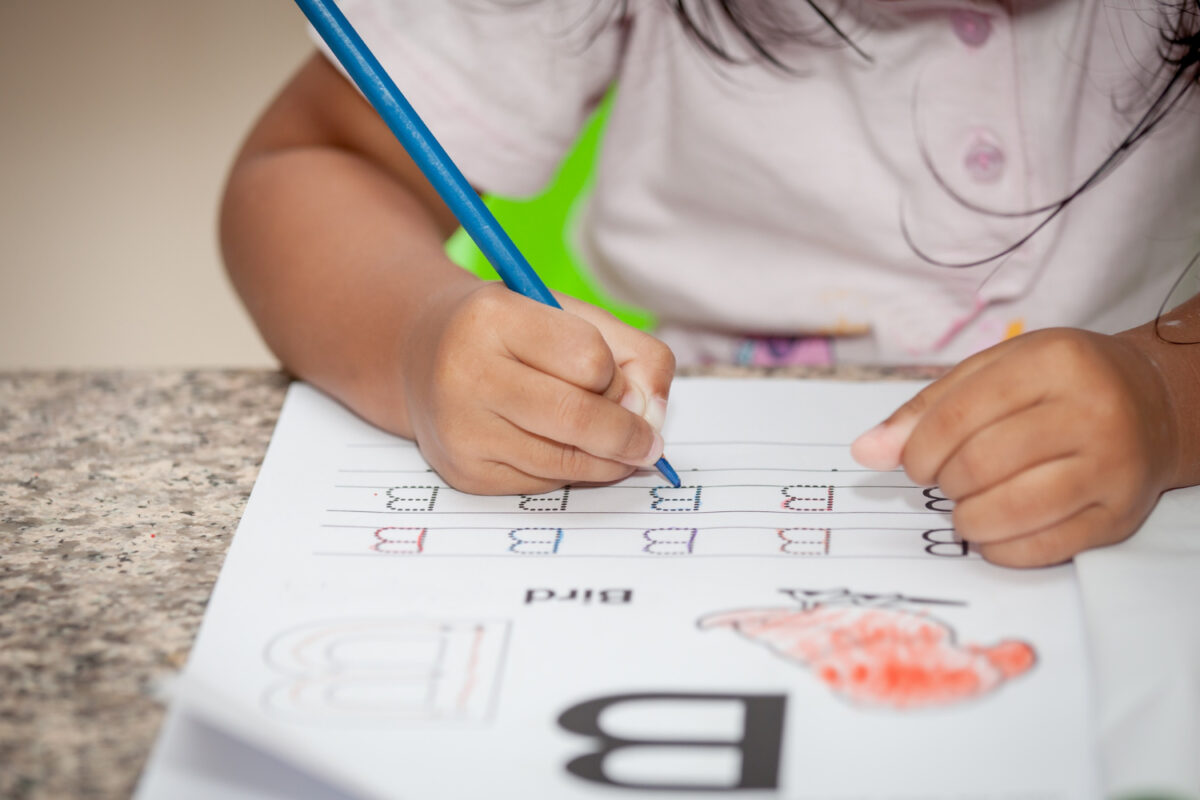
Pick one lowercase letter. Use a card or sheet that shows a clear start dot and arrow sequence. Model the stroke once with your finger while saying the letter sound, not the letter name (“/m/,” not “em”). Then invite the child to trace six small boxes, each a single clean attempt. If box five goes messy, stop at five. Ending on a tidy example matters more than hitting a quota. The purpose here is motor programming: you are training a tiny choreography the hand can replay later without conscious effort.
Phase 2 — Three minutes: Letter Path Maze.
Immediately shift to a page where the letter shape is enlarged into a “path” or simple maze. The child drives a pencil along the path from start to finish. There is no speed bonus; slower is better. This step loads visual tracking and spatial planning on top of the motor plan you just built. The maze acts as a magnified reminder of directionality—up, around, down—without the fatigue of tiny handwriting lines.
Phase 3 — Three minutes: Sound match.
Present a small set of pictures where one begins with the target sound and the others do not (e.g., moon, car, sun; target is m). Say the words out loud and have the child point, circle, or place a sticker on the correct picture. Say the sound again as you reinforce the match. Now you’re tying the phoneme to a meaning anchor. This links the body’s memory of the stroke to a sound that appears in real words.
Phase 4 — Two to four minutes: Review game.
End with something playful and short: a quick “mix and pick” of yesterday’s letter versus today’s, or a tiny “say & trace” race using a plastic sleeve and dry-erase. The goal isn’t speed; it’s retrieval—asking the brain to pull up the form and sound without re-teaching. Retrieval is what makes learning stick.
That’s it. Close the notebook while energy is still high. Put a small sticker in a “Done” box. Tomorrow, you do it again with a new letter or a strategic review.
Why this works (without the jargon)
Young learners do not benefit from longer sessions; they benefit from clean repetitions that end before control breaks down. The 2–3 Method respects attention spans, limits the number of motor attempts, and overlays complementary cues. The tracing phase gives the how, the path phase gives the where, and the sound match gives the why. Finishing with a short review signals completion and invites pride—a quiet but powerful motivator for tomorrow’s session.
Choosing letters and pacing
Start with high-utility lowercase shapes that differ clearly from each other and appear often in simple words. A common opening set is a, m, t, s, c, r. Avoid near-lookalikes back-to-back (e.g., b/d or p/q). Introduce two or three new letters per week, with review days mixed in. If a letter is consistently sloppy after three days, pause new content and run two days of 2–3 Method only on that letter plus one you already own well. Do not escalate the length of pages; escalate precision and consistency.
What good materials look like
Use cards or sheets that show start dots, arrows, and generous spacing. Avoid cramped baselines and crowded word lines. For the path phase, the letter should fill most of the page as a smooth track. For sound matches, choose images with obvious first sounds and minimal visual clutter. A small upgrade that helps many children is a triangular pencil or a narrow marker; it cues the fingers into a stable grip without lectures about “pinch and rest.”
Implementation script (so you know what to say)
“Today our letter is m. Here’s the path my pencil takes—/m/—down, bump, bump. Now it’s your turn. One neat /m/ here… beautiful. And another. Stop. Look how the bumps match. Now drive the big m road—slow wheels. Great. Three pictures: moon, car, sun. Which one starts with /m/? Yes—moon. Last game: I’m hiding m and a under these cards—pull one, say the sound, and give it a neat trace.”
You’ll notice the script stays on sounds, not letter names, and praises features (“bumps match,” “slow wheels”), not vague effort (“good job”).
A fourteen-day sequence you can follow
Day 1: a → trace six boxes; path; sound match; review with cover-and-say.
Day 2: m → same structure; end with a vs. m pick-and-trace.
Day 3: t → same; end with quick three-card review (a/m/t).
Day 4: review day → choose any two letters from a, m, t; run full 2–3 Method on each for half time.
Day 5: s → introduce; end with s vs. a.
Day 6: c → introduce; end with c vs. m.
Day 7: r → introduce; end with r vs. t.
Day 8: consolidation → pick three letters that felt wobbly; run shortened phases.
Day 9: new letter from your list (e.g., n); keep one strong review letter.
Day 10: new letter (e.g., o); review an earlier curve letter (a or c).
Day 11: spacing check → fewer traces, slower paths; add a two-picture sound choice to reduce guessing.
Day 12: contrast day → pick two letters with different strokes (e.g., m and o) and alternate every minute.
Day 13: micro-words → if child is ready, build am, at, an using letter tiles after the main phases; keep it under two minutes.
Day 14: celebration review → child chooses two favorite letters; add a photo of neat work to a progress page.
This is not a race to twenty-six. It’s a race to clarity on each letter you touch.
Troubleshooting the common snags
If tracing goes sloppy after box three, stop at three and call it a win. Tomorrow you might reach four. If the path phase turns into scribbling, put a tiny sticker at the finish dot so the child is “driving to the sticker,” not wandering. If sound matches are mostly guessed, reduce the field to two pictures and say the words slowly, exaggerating the first sound. If grip collapses, switch the tool, not the child—triangular pencils or short golf pencils reduce fatigue; the reminder is built into the tool.
Above all, resist the urge to add more pages when results stall. The lever isn’t length; it’s quality per attempt and consistency per day.
Measuring progress without pressure
You don’t need a rubric to feel improvement, but two simple checks help. First, keep a two-photo timeline for each letter: day one vs. day three. You’re looking for cleaner starts and consistent direction, not perfection. Second, run a ten-second retrieval: cover the model and ask for a single neat letter while saying the sound. If it appears without struggle, you own it. If not, you need another day at the same dosage.
For classrooms and siblings
The method scales. In a small group, give each child a different letter aligned to their current need and rotate the phases together by timer. For siblings, seat them side by side with different letters and swap only the sound-match phase so they “teach” each other by saying the words aloud. Avoid head-to-head comparisons. Everyone earns the same two-minute celebration at the end: a sticker or the right to choose tomorrow’s sound picture set.
Materials to download
To make this effortless, we prepared an A–Z Starter with everything in the correct order: arrow-guided tracing cards for A–F, three letter path sheets, and three sound-match pages. There’s also a one-page parent guide and the fourteen-day plan above. Grab it, print once, and place the sheets in a slim folder so you can start tomorrow without hunting for materials.
Get the A–Z Starter (Free 12 pages) + 45-second Quiz to generate a personalized 14-day path based on your child’s age, current letters, and attention profile. The quiz asks what your child already recognizes, whether grip or sound mapping is harder, and how many minutes you can reliably do each day. The system then schedules which letters to introduce, which to review, and when to attempt simple vowel blends.
Alphabet time shouldn’t feel like trench work. When you keep it short, sequence the cues, and end while it’s still enjoyable, the brain does the rest. Two minutes of exact tracing, three minutes of pathfinding, three minutes of sound mapping, and a tiny retrieval game—that is the 2–3 Method. Try it for a week. The pages get neater. The sounds come faster. And your child begins to believe, correctly, that letters are learnable.
The roadmap may vary for each child. Get guided steps for tailored packages for your kids!